Topping the TriWorldBench Leaderboard! Visincept's WorldIncept Claims the No.1 Spot on the Multi-View Robotic World Model Benchmark
Abstract: Visincept's world model, WorldIncept, claims the top spot on the overall TriWorldBench leaderboard with a score of 71.84. It ranks No.1 in temporal consistency and No.2 in task alignment. Among nearly 70 submitted models, it is also the only entry that lands within the top 8 across all six evaluation dimensions with no obvious weaknesses.
The leaderboard for TriWorldBench, a benchmark for evaluating multi-view embodied world models, has recently been updated. WorldIncept, the proprietary world model developed by Visincept, secured the overall No.1 position with a score of 71.84. Across the six evaluation dimensions, WorldIncept achieved top-three rankings in multiple sub-tasks while maintaining balanced, strong performance in all six categories without notable weak points, which is a feat unmatched by nearly 70 competing models. This marks another first-place finish for WorldIncept in robotic world model evaluations, following its victory in the CVPR 2026 WorldArena 2.0 Challenge.
TriWorldBench is jointly initiated by Peking University, Tsinghua University, Beihang University, Shanghai Jiao Tong University, the University of Science and Technology of China, and other institutions. It assesses whether a world model can predict the future of a robotic manipulation action coherently and synchronously from three camera viewpoints: the robot's head camera, left wrist camera, and right wrist camera. On this leaderboard, merely generating "plausible-looking" outputs is insufficient for a high score. Models must grasp the underlying mechanics of actions and accurately reason about multi-view camera geometry.
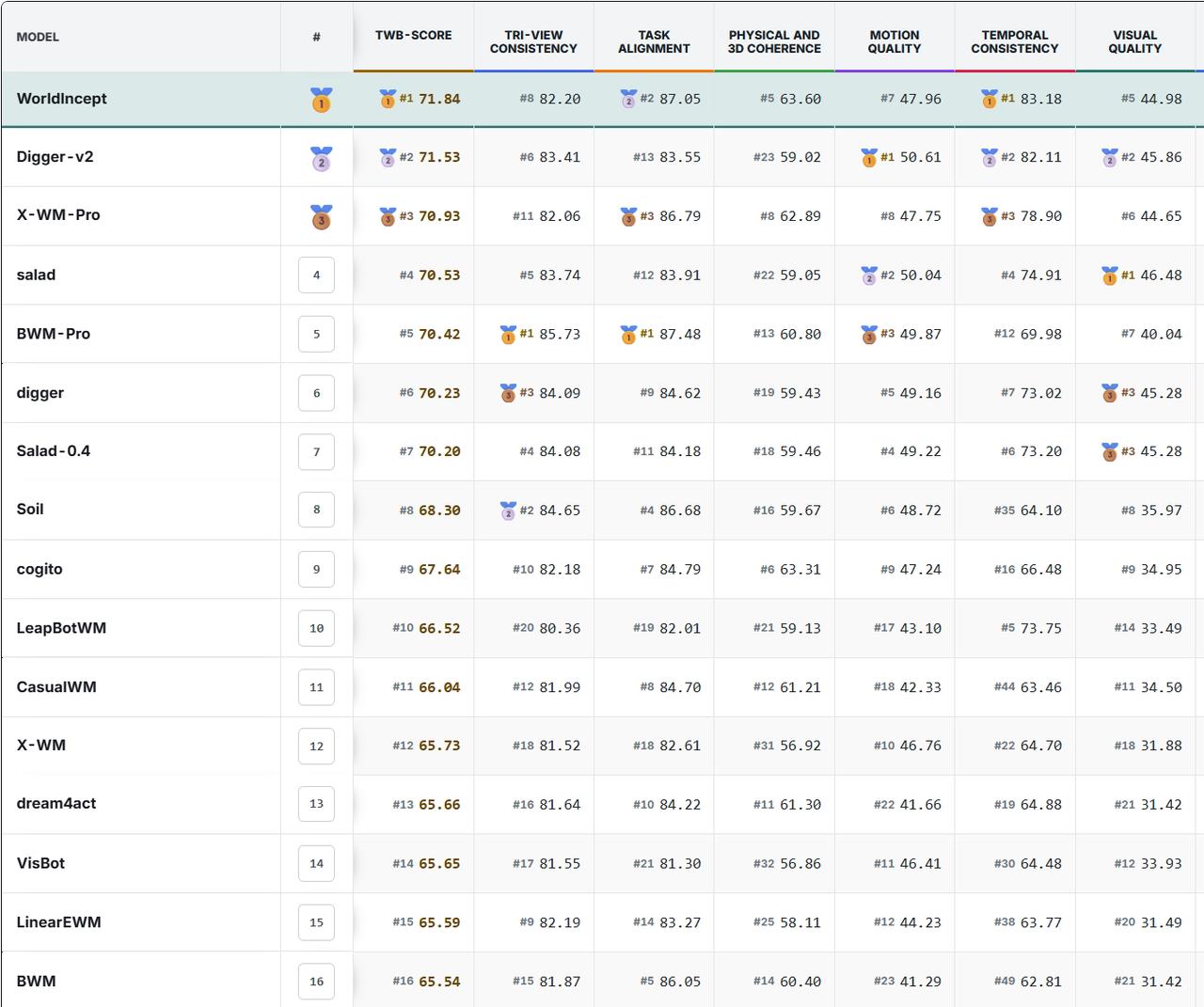
Figure 1: Top entries on the overall TriWorldBench leaderboard. WorldIncept ranks first with a score of 71.84 (as of October 30, 2026, out of nearly 70 models)
A Benchmark Where "Looking Reasonable" Is Not Enough: Leading Requires Balanced Performance Across 19 Metrics
When robots perform manipulation tasks, they typically observe the world through multiple cameras simultaneously. The head camera provides a global view of the workspace and task progress, while the left and right wrist cameras sit close to the grippers to capture fine-grained contact, grasping, and subtle object changes. Built upon RoboTwin 2.0, TriWorldBench features 50 bimanual manipulation tasks and 500 synchronized test clips, covering pick-and-place, stacking, pouring, bimanual handover, switch operation, and tool use. Each clip supplies initial frames from the three cameras, a task instruction, and an action sequence. The world model is required to predict what will unfold next from all three viewpoints while enforcing multi-view consistency.
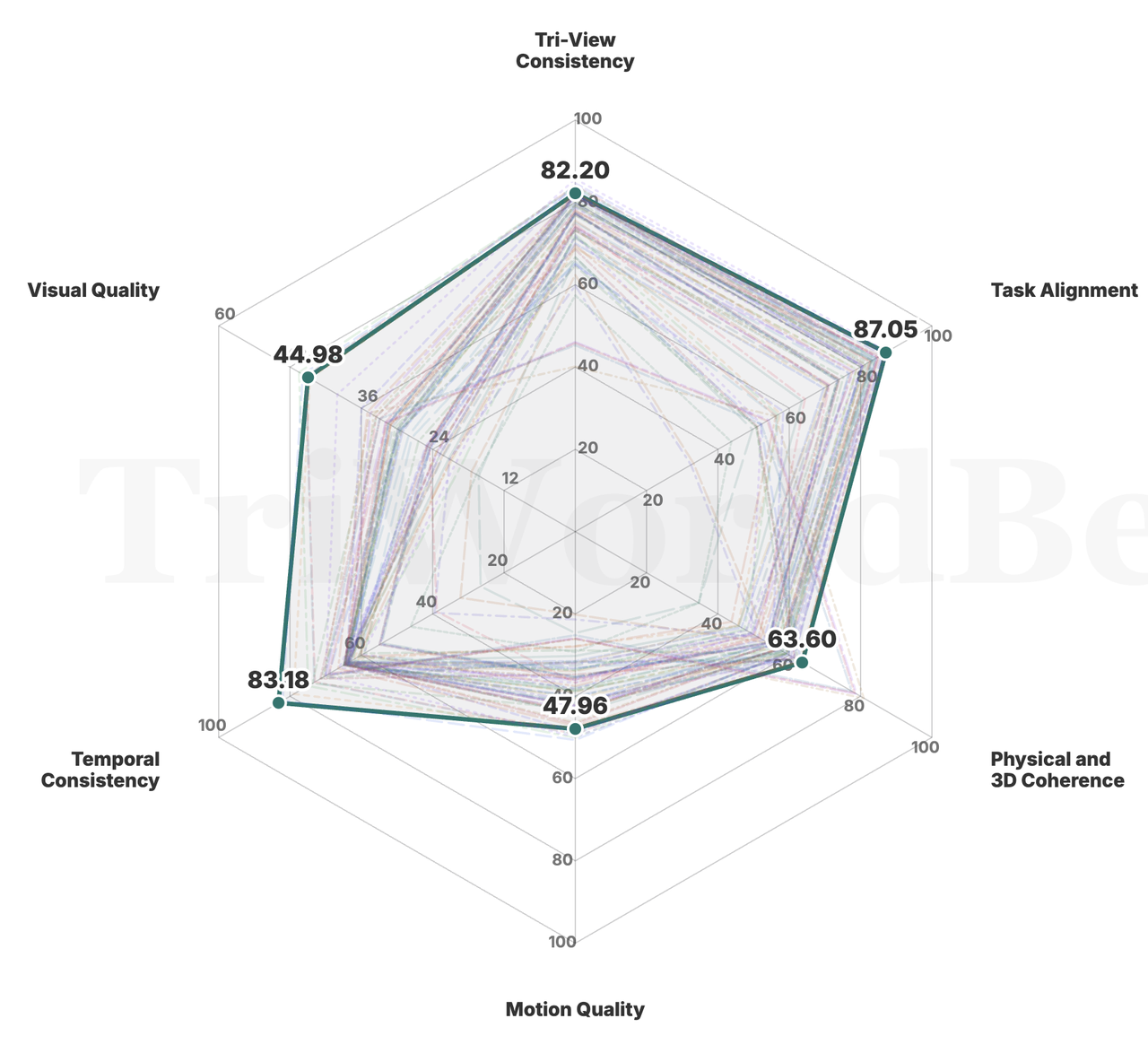
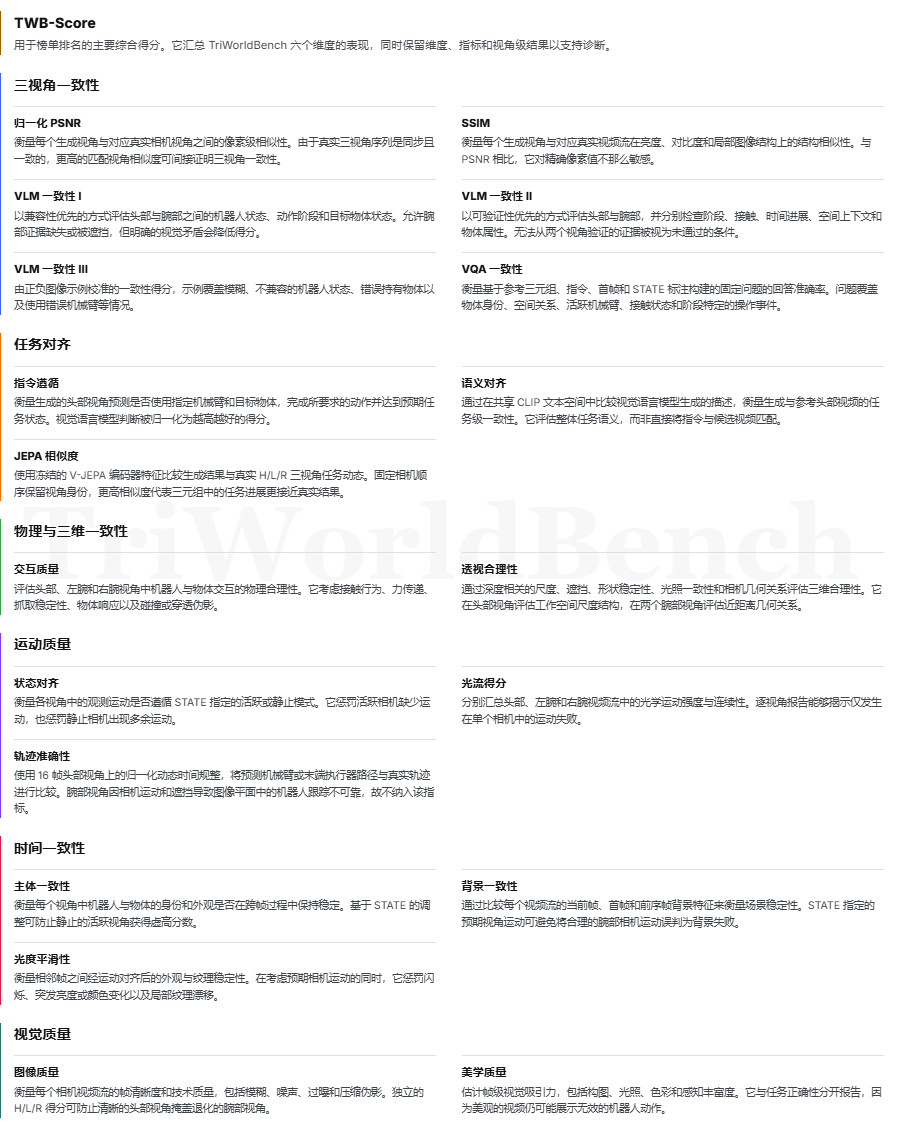
Figure 2: The six evaluation dimensions and 19 metrics of TriWorldBench (Source: TriWorldBench official website)
The three viewpoints must tell the same consistent story. A scenario where an object appears firmly grasped in the head view yet slips in the wrist views, or where three individually realistic video clips contradict one another on whether an object has been lifted, will incur penalties during cross-view validation.
What should move moves; what should stay still stays still. Evaluations reference ground-truth trajectories to specify which arm should be in motion and which camera should shift at each stage. Stability obtained by freezing frames earns no points, and spurious unintended motion is penalized.
Visual polish does not equal correctness. If trajectories in the head viewpoint are erroneous, or if the three views disagree on the states of robotic arms and objects, scores for image quality and visual aesthetics will be discounted.
As of October 30, nearly 70 models have published results on TriWorldBench. WorldIncept delivers balanced top-tier performance across all six dimensions with no obvious weaknesses and attains top-three rankings in multiple sub-metrics. Competitors include well-known world models and video generation systems from the industry, such as BWM, genie-envisioner, Cosmos, motus, XiaomiAutoWM, DreamDojo, HY_World, and more.
For this submission, WorldIncept builds on the foundation world model developed by Visincept for the WorldArena 2.0 tasks, with continuous refinements to physical consistency, semantic alignment, and 3D accuracy. TriWorldBench imposes stricter requirements on multi-view and temporal consistency, so the team implemented targeted algorithmic upgrades and post-training atop the base architecture. To meet cross-view consistency demands, WorldIncept leverages spatio-temporal joint attention to exchange information and align multi-view video generation across the three viewpoints, alongside epipolar constraints for efficient cross-view communication. For long-horizon temporal consistency, a multi-scale historical memory mechanism enables efficient memory retention and alignment over extended sequences. As a result, while retaining well-rounded performance, WorldIncept achieves standout results in 3D spatial structure, task alignment, temporal consistency, and other key areas.
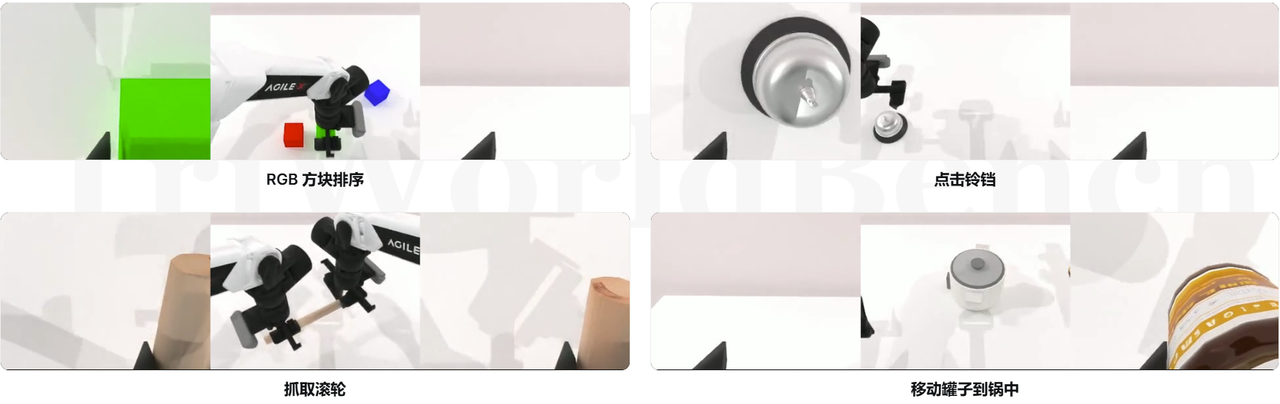
Figure 3: WorldIncept multi-view prediction sample (left to right: left-wrist view, head view, right-wrist view)
WorldIncept is a robot-manipulation-focused world model developed by Visincept. It is built around three core pillars: structured robot-and-object representations, action-aligned prediction, and causality-driven dynamic modeling. It generates long-horizon, multi-view videos that conform to realistic physical interactions. TriWorldBench serves as another comprehensive validation of WorldIncept’s current visual world modeling capabilities and lays the groundwork for its future deployment in embodied intelligence, simulation training, and robot learning workflows.
About Visincept
Visincept is an AI startup incubated by the IDEA Research Institute. It closed an angel financing round of nearly 100 million RMB in 2025. Its vision is to build vision-native world models and advance toward super-physical intelligence.
The company has launched the DINO-X visual model series, the DINO-XGrasp universal grasping model, and flexible manipulation brains for robotic arms. It also partnered with Baidu Intelligent Cloud to launch the EgoTwin data engine, helping models learn physical laws and causal interactions from internet-scale data and human egocentric data.
Visincept develops a unified generative-and-understanding world model. Inheriting DINO-X's industry-leading capabilities for object and action understanding, it achieves SOTA performance in reasoning over physical rules and causal interactions. The company strives to bring AI into the physical world.
References: